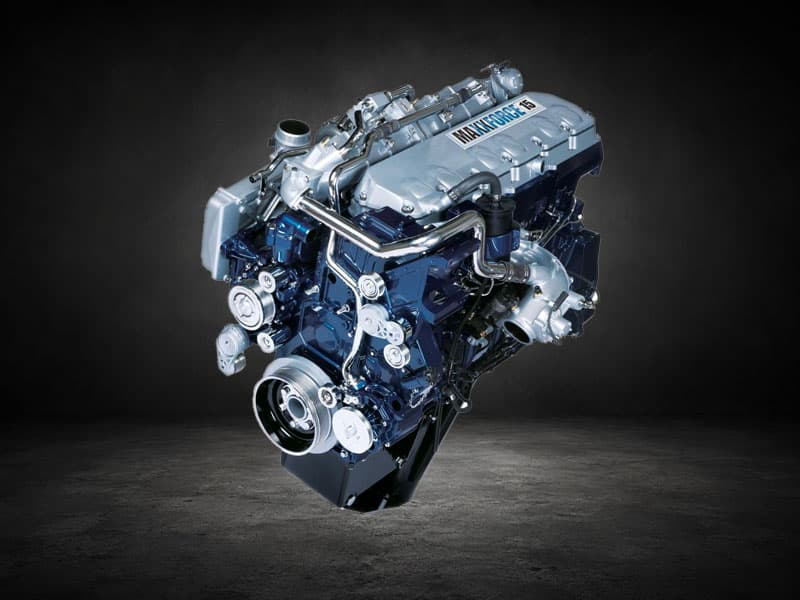
The Cummins-Block MaxxForce
The Navistar MaxxForce 15 is the most unusual member of the MaxxForce family — a 14.9-liter inline-six that's essentially a Cummins ISX engine block fitted with Navistar's calibration architecture and emissions strategy. The platform existed because of the Navistar-Cummins partnership that operated through the late 2000s, where Cummins supplied the engine hardware and Navistar took responsibility for emissions integration and calibration. Production ran from 2008 to 2013, with the MaxxForce 15 appearing in International ProStar heavy-spec, International LoneStar heavy-haul, and other International heavy-duty Class 8 configurations.
Power ratings on the MaxxForce 15 ran from 475 to 550 horsepower with peak torque from 1,650 to 1,850 lb-ft. The combination of Cummins ISX engine fundamentals with Navistar's EGR-only emissions strategy produced a platform with a distinctive set of operational characteristics — strong underlying engine architecture inherited from the proven ISX platform, paired with the troubled aftertreatment philosophy that defined the broader MaxxForce family.
Why MaxxForce 15 Trucks Come To Our Bench
MaxxForce 15 calibration work has a specific operational pattern. The underlying ISX engine hardware is genuinely strong — the same architecture that powered Cummins ISX trucks for years of reliable heavy-haul service. The problems on MaxxForce 15 trucks come specifically from the Navistar emissions integration, not from the engine itself:
EGR-only architecture stress. Navistar's bet on meeting EPA 2010 NOx limits through massive EGR rates rather than SCR put extreme load on the EGR system. On the Cummins ISX engine block, this produced predictable aftertreatment failures even though the underlying engine hardware could have handled different operational strategies more gracefully.
EGR cooler failures. Standard MaxxForce family pattern, applied to the Cummins ISX-based architecture. Coolant intrusion into intake, intermittent fault codes, eventual catastrophic failure.
DPF clogging from sustained heavy-haul duty. MaxxForce 15 trucks in heavy-haul service produce high soot loads that the DPF has to handle. Combined with the EGR-heavy strategy producing additional soot, the aftertreatment system runs near its operational limits during normal heavy-haul operation.
Navistar/Cummins hybrid calibration complexity. The MaxxForce 15's hybrid nature — Cummins engine block with Navistar emissions integration — produces calibration challenges that pure Cummins or pure Navistar work doesn't have. Understanding both ecosystems is required to work the platform effectively.
What Programming Can Do For The MaxxForce 15
The interesting thing about the MaxxForce 15 from a calibration standpoint is that the underlying engine hardware is genuinely capable. Removing the Navistar EGR-heavy emissions strategy through delete calibration returns the engine to operating characteristics closer to what the Cummins ISX architecture was designed for. This isn't a band-aid — it's restoring the platform to its underlying mechanical capability after stripping away an emissions strategy that didn't work as designed.
For heavy-haul, oilfield, and export applications, combined DPF and EGR delete eliminates the aftertreatment failure surface and lets the engine run against the substantial headroom of the Cummins ISX hardware. For on-road trucks staying in compliant service, recalibration after aftertreatment hardware repair restores normal operation and clears the inducement countdowns that would otherwise re-trigger faults shortly after dealer service.
Performance tuning on the MaxxForce 15 has more headroom than on most MaxxForce family platforms specifically because the underlying engine architecture supports it. Stock-hardware gains of 50-100 hp with proportional torque are achievable within safe envelopes on most rating variants.
ECM Identification
MaxxForce 15 trucks run a hybrid diagnostic architecture — Navistar's calibration ecosystem accessed through the standard SAE J1939 9-pin connector. The calibration libraries are MaxxForce 15-specific and require understanding of both the Cummins ISX hardware foundation and the Navistar emissions integration philosophy.
Sending us the truck VIN, engine serial number, and current calibration ID lets us scope the work and identify the correct calibration library before any quote. For MaxxForce 15 customers in particular, we ask about the specific operational situation driving the work because the platform supports a wider range of calibration outcomes than most MaxxForce family engines.
Service Paths For MaxxForce 15 Programming
Ship-in is the most common path. Pull the ECM, ship to Fort Lauderdale, 2-3 day turnaround. Remote programming is possible with the right diagnostic hardware. On-site service is available for South Florida operators bringing the truck to us.
Quotes return same business day. Tell us the year, the chassis (ProStar heavy-spec, LoneStar), current fault codes, and intended use case. The MaxxForce 15 is one of the more interesting platforms in the MaxxForce family because of its Cummins-ISX foundation — the calibration work has more useful outcomes available than most MaxxForce platforms support, and the conversation usually centers on what the operator wants the truck doing rather than just on damage control.
The MaxxForce 15 In Heavy-Haul Context
For heavy-haul operators who chose International ProStar or LoneStar trucks with MaxxForce 15 power during the platform's production window, the operational story has been complicated. The underlying engine hardware delivered on its capability — the trucks pulled what they were spec'd to pull, the durability of the Cummins ISX foundation showed itself in service — but the Navistar emissions integration produced recurring aftertreatment costs that ate into the operational economics over time. Today, the heavy-haul MaxxForce 15 community is small but dedicated, with operators who've found ways to manage the platform's quirks and who keep the trucks running because the underlying capability still justifies the effort. We support that community with calibration work that respects what the platform can actually do.