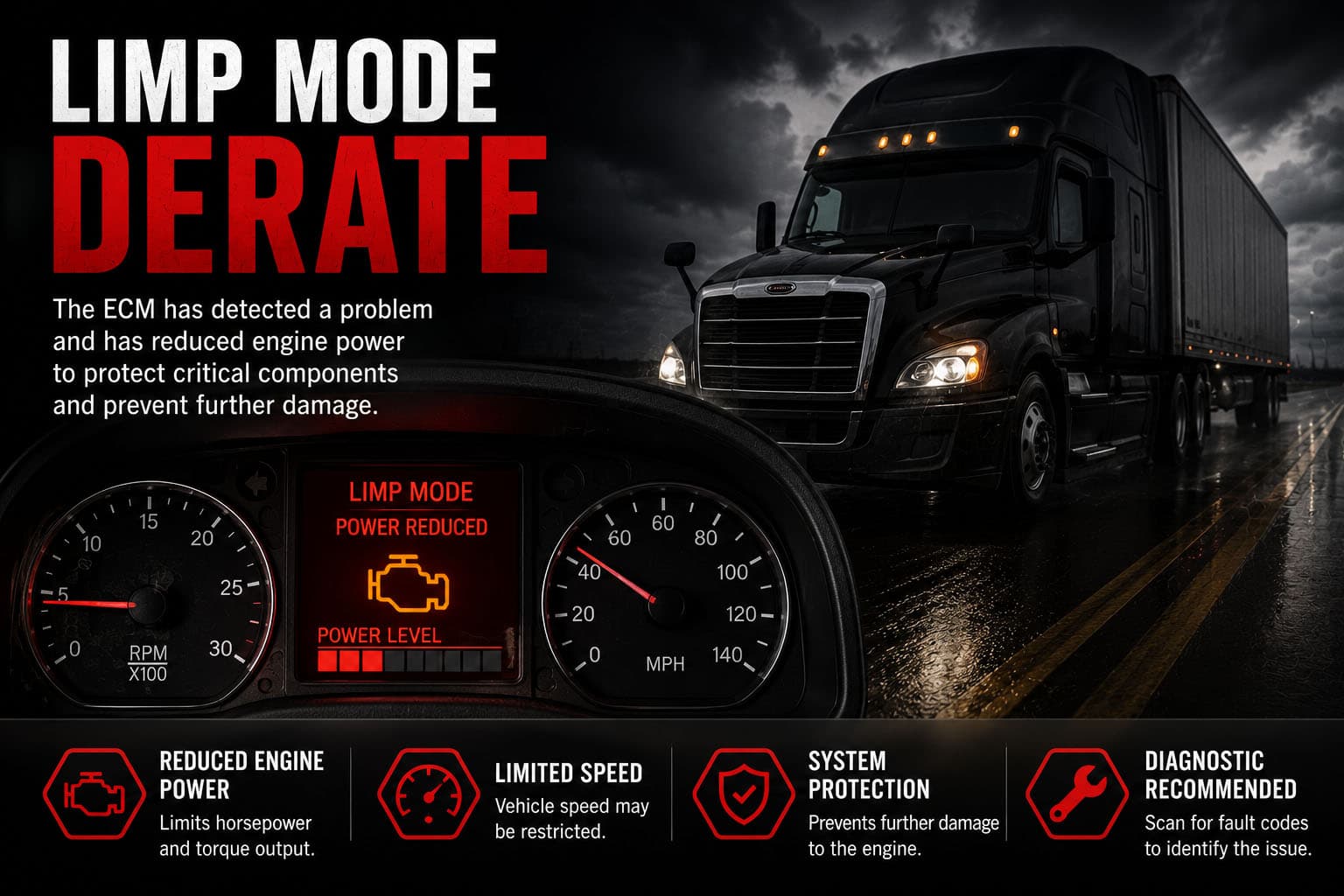
What Limp Mode Actually Is
Limp mode — also called derate, engine protection, reduced power mode, or limp-home — is the ECM's response to detecting a condition outside the safe operational envelope. Rather than continue normal operation and risk catastrophic damage (or out-of-compliance emissions), the ECM restricts power output to protect the engine and aftertreatment system.
Typical derate stages reduce torque to 70%, then 50%, then 25%, and finally the truck enters severe restriction (often 5 mph maximum or stationary-only operation). Each stage is a stair-step toward forcing the operator to address the underlying issue. The progression timing depends on the underlying cause and the manufacturer's specific inducement schedule.
The driver experience is unmistakable. The truck still runs but can't perform work. The dashboard tells the story — usually with red stop-engine, amber check-engine, or specific aftertreatment indicators. Sometimes the truck shifts directly to derate mid-route; sometimes it powers up in derate after a cold start. The operational disruption is immediate and absolute.
The Most Common Underlying Causes
Limp mode is a symptom with many possible root causes. The specific cause matters because resolution depends on it — generic derate treatment usually fails because it doesn't address the actual issue.
Aftertreatment-driven derate (most common on post-2007 trucks)
DPF accumulation past threshold with failed regen sequences. DEF dosing failures on EPA 2010+ trucks. NOx sensor drift triggering inducement countdown sequences that drive the truck into derate after the warning interval elapses. SCR catalyst efficiency drops. These are the dominant derate causes on modern fleet trucks. The pattern typically appears as recurring derate events that an operator initially treats individually before recognizing the fleet-wide pattern.
EGR system failures
EGR cooler failure flooding intake with coolant produces a cluster of fault codes and immediate derate response. EGR valve failures, position sensor drift, and related EGR system issues all eventually drive derate. EGR-driven derate often appears suddenly rather than building gradually like aftertreatment-driven derate.
Coolant and thermal limits
Coolant temperature exceeding limit. Engine oil pressure drops. Aftertreatment temperature outside expected range. These thermal-protection-driven derates reflect actual engine protection rather than emissions-driven restrictions, and the underlying issues need addressing before the truck can return to normal operation safely.
Fuel system issues
Fuel pressure drops, injector failures, fuel quality issues all contribute to derate-driving fault codes. Fuel-driven derate sometimes resolves itself when fuel quality changes (different fueling location, new fuel batch) which can mask the underlying pattern.
How We Diagnose The Specific Cause
Effective derate resolution starts with reading the active fault codes. Generic "the truck is in derate" doesn't tell us enough — the specific SPN/FMI fault codes (or J1939 equivalent codes) point at the underlying cause. Cummins INSITE, Paccar Davie4, Volvo PTT, Mack PTT, Detroit DDDL, Cat ET, and MaxxForce ServiceMaxx all let us pull fault code data, freeze-frame information, and operational history that narrows the root cause.
For customers without dealer-grade diagnostic access, our remote diagnostic service lets us walk through the issue together — share fault code screenshots or photos of the dashboard, describe the operational context (when it started, what was happening at the time, what's been done so far), and we can typically narrow the root cause before any ECM ships to us.
For fleet customers running multiple trucks with similar derate patterns, we often identify a fleet-wide calibration or operational issue that drives recurring derates across the fleet rather than treating each truck as an isolated incident. Pattern recognition across the fleet population frequently surfaces causes that aren't obvious from any individual truck's diagnostic history.
Resolution By Root Cause
The right path depends on what's driving the derate. There is no universal derate fix because there is no universal derate cause.
Aftertreatment-driven derate from DPF accumulation typically needs the combination of hardware service (DPF cleaning, possible substrate replacement) plus calibration work that addresses the underlying operational mismatch. DEF dosing and SCR-driven derate often need NOx sensor service, DEF dosing injector service, and SCR catalyst inspection alongside calibration approaches. EGR-driven derate needs EGR cooler service or replacement plus calibration work. Thermal and coolant-driven derate points at fundamental hardware issues that need addressing before calibration work can hold.
For trucks where ongoing aftertreatment service represents an unsustainable operational economic burden — particularly off-road and export-bound trucks — combined DPF + EGR + SCR delete with appropriate calibration eliminates the entire aftertreatment-driven derate surface. This isn't a path for compliant on-road service, but it's the right path for trucks where the regulatory situation permits and the operational economics demand it.
Fleet-Wide Derate Patterns
Fleet operators tracking recurring derate events across their inventory typically discover that derate isn't random. The trucks that hit derate this week and the trucks that will hit it next month often share underlying patterns — similar mileage thresholds, similar duty cycles, similar service histories, similar calibration vintages. Recognizing the pattern at the fleet level surfaces causes that any individual truck's diagnostic record might miss.
We work with fleet customers to map derate events across the fleet population, identify the operational and mechanical patterns driving the recurring failures, and develop service approaches that address the underlying issue rather than treating each truck as an isolated incident. The conversation typically uncovers calibration adjustments that benefit the broader fleet, service scheduling approaches that reduce operational disruption, and operational changes that extend the time between derate events on trucks that haven't yet failed.
For fleets running 10 to 200 mixed trucks, this kind of pattern analysis often delivers operational improvements that substantially exceed what individual-truck reactive service can produce. The trucks that haven't yet failed are the operational opportunity — addressing the underlying patterns before failure is consistently more economical than addressing each failure after it occurs.