The Aftertreatment Fuel Injector Explained
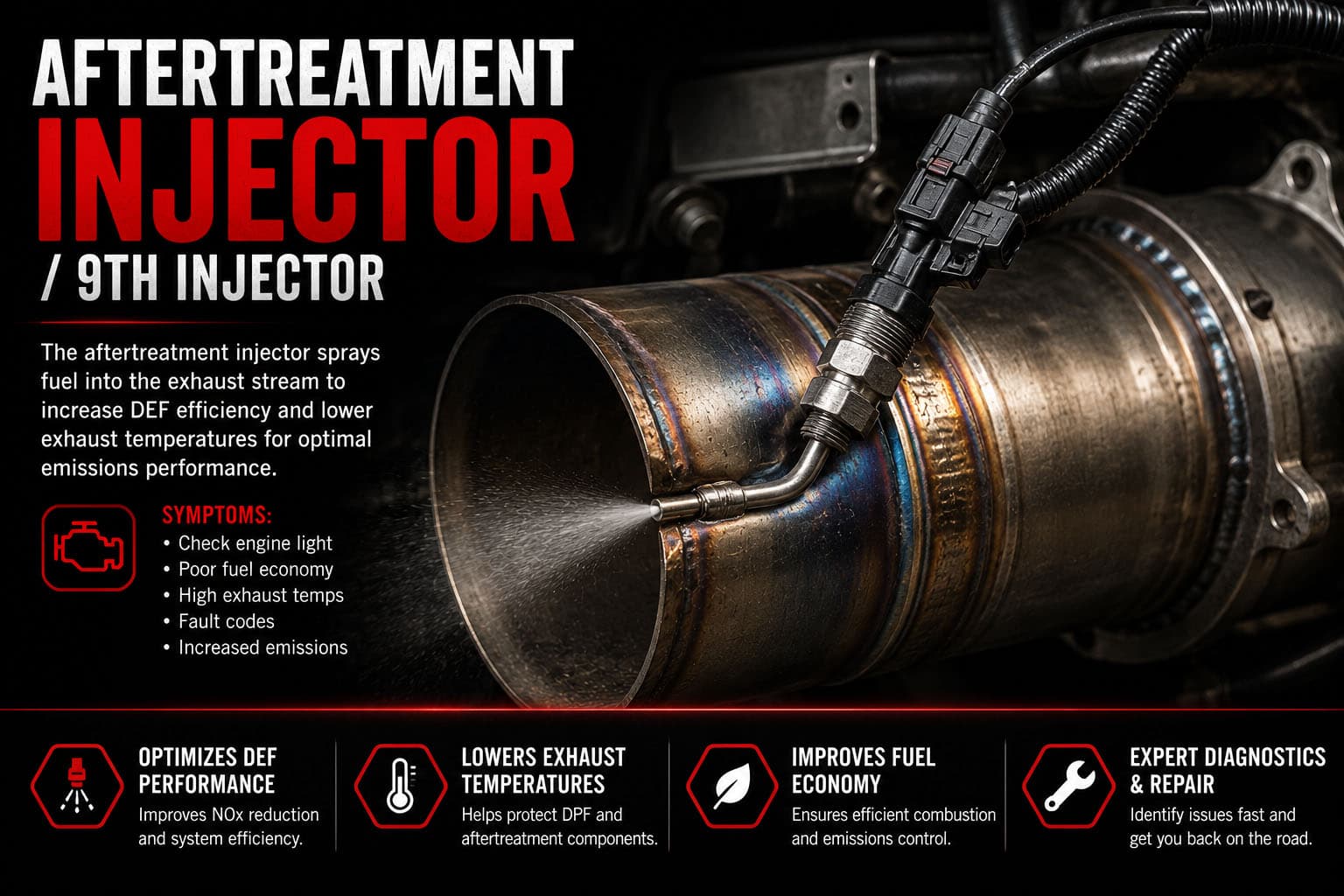
The "9th injector" — also called the HC dosing injector, AFI (aftertreatment fuel injector), or hydrocarbon dosing injector depending on the manufacturer — sits in the exhaust stream ahead of the DOC and DPF. During active regen, the ECM commands the injector to spray diesel fuel into the exhaust gas.
That fuel oxidizes across the DOC, raising exhaust temperature to the 1100-1200°F range needed to oxidize soot in the DPF substrate downstream. The injector is critical to active regen function — when it fails, the truck loses the ability to regenerate the DPF at all.
The injector itself is a relatively small fuel injector mounted in the exhaust pipe, fed by a dedicated fuel line tapped off the main fuel rail. It must reliably atomize fuel into a high-temperature high-velocity exhaust stream that wants to coat it in carbon, while staying electrically functional in an extremely hot environment. Failure modes accumulate from this operational environment over operational service life.
Common Failure Modes
Carbon buildup at the injector tip
The dominant failure mode. Diesel fuel sprayed into hot exhaust gas inevitably produces carbon deposits when injector cycling stops between regen cycles. The deposits accumulate on the injector tip, restrict the spray pattern, eventually plug the orifices entirely. Trucks operating in conditions that produce frequent failed regens accelerate this — each failed regen ends with the injector ceasing operation while the tip is still hot, leaving fuel residue that bakes onto the tip.
Electrical connector and wiring failures
The injector lives in an extremely hot environment under the truck. Electrical connectors corrode, wiring insulation degrades from heat exposure, and the electrical interface between ECM and injector eventually fails. Fault codes for "aftertreatment fuel injector electrical" point here.
Fuel contamination clogging the injector
Water in fuel, off-spec diesel, or fuel additive incompatibilities can clog the injector internally. This appears more commonly in operations with mixed fuel sourcing or in regions with variable fuel quality.
Fuel pressure issues upstream
The injector needs adequate fuel pressure to atomize properly. Issues upstream — failing aftertreatment fuel pump, restricted fuel filter, fuel system air ingress — affect injector spray quality even before the injector itself fails.
What Drivers And Mechanics See
Active regen attempts that don't complete despite the truck spending substantial time in the regen cycle. Exhaust temperatures during regen that fail to reach target. Fault codes specific to the aftertreatment fuel injector — SPN 3479, SPN 3480, SPN 5443, and platform-specific equivalents.
DPF accumulation patterns building toward derate even though regens are attempting frequently. In severe cases, fuel pooling in the exhaust system if the injector sticks open, producing dramatic white exhaust and potential DPF damage from uncontrolled high-temperature events. The injector failure pattern often appears alongside excessive regen cycles — the ECM commands more frequent regens to address DPF accumulation, but the injector can't deliver adequate fuel to complete them, and the cycle accelerates toward derate.
Resolution
Effective resolution requires replacing the failed injector hardware. Some shops attempt cleaning service on carbon-fouled injectors with variable results — heavily fouled injectors typically need replacement rather than cleaning. Replacement requires correct calibration registration of the new injector in the ECM. After replacement, calibration reset clears the accumulated fault history.
For trucks in dedicated off-road service or bound for export — where the entire aftertreatment system is being removed via DPF delete — the 9th injector comes out as part of the delete and the calibration removes the injector logic entirely. This is the appropriate path when the truck won't see public road service and the operational economics of recurring aftertreatment service don't make sense.
For trucks staying compliant, we coordinate with operators on the hardware service path (typically operator-arranged at a service facility with diesel diagnostic capability) and provide calibration work that addresses any underlying calibration issues that contributed to the failure. Often the injector failure is itself a symptom of broader operational mismatch — calibration work that addresses the root cause can prevent the failure from recurring on the replacement injector.
Preventive Calibration Approaches
Aftertreatment fuel injector failures are largely predictable from operational patterns, which means calibration work that addresses the underlying patterns can substantially extend injector service life rather than just responding to failures after they occur.
The dominant injector failure driver is carbon accumulation at the injector tip, which accelerates dramatically when regen cycles fail to complete. Each failed regen ends with the injector ceasing operation while its tip is still hot, leaving fuel residue that bakes onto the tip and accelerates the next failure. Trucks operating in conditions that produce frequent failed regens see injector failure substantially earlier than trucks operating in conditions where regens complete cleanly.
Calibration approaches that improve regen completion rates — better matching the calibration to the truck's actual operational duty cycle, adjusting regen trigger thresholds to match operational reality, addressing the underlying conditions that produce failed regens — also extend injector service life as a downstream benefit. The same calibration work that reduces derate events typically reduces injector replacement frequency.
For fleet operators experiencing recurring 9th injector failures across multiple trucks, the diagnostic conversation should look at whether the underlying operational pattern is producing the recurring failures rather than treating each injector replacement as an isolated event. Addressing the pattern at the calibration level often delivers operational improvements that compound across the broader aftertreatment service ecosystem.