Why Cold Weather Breaks Regen
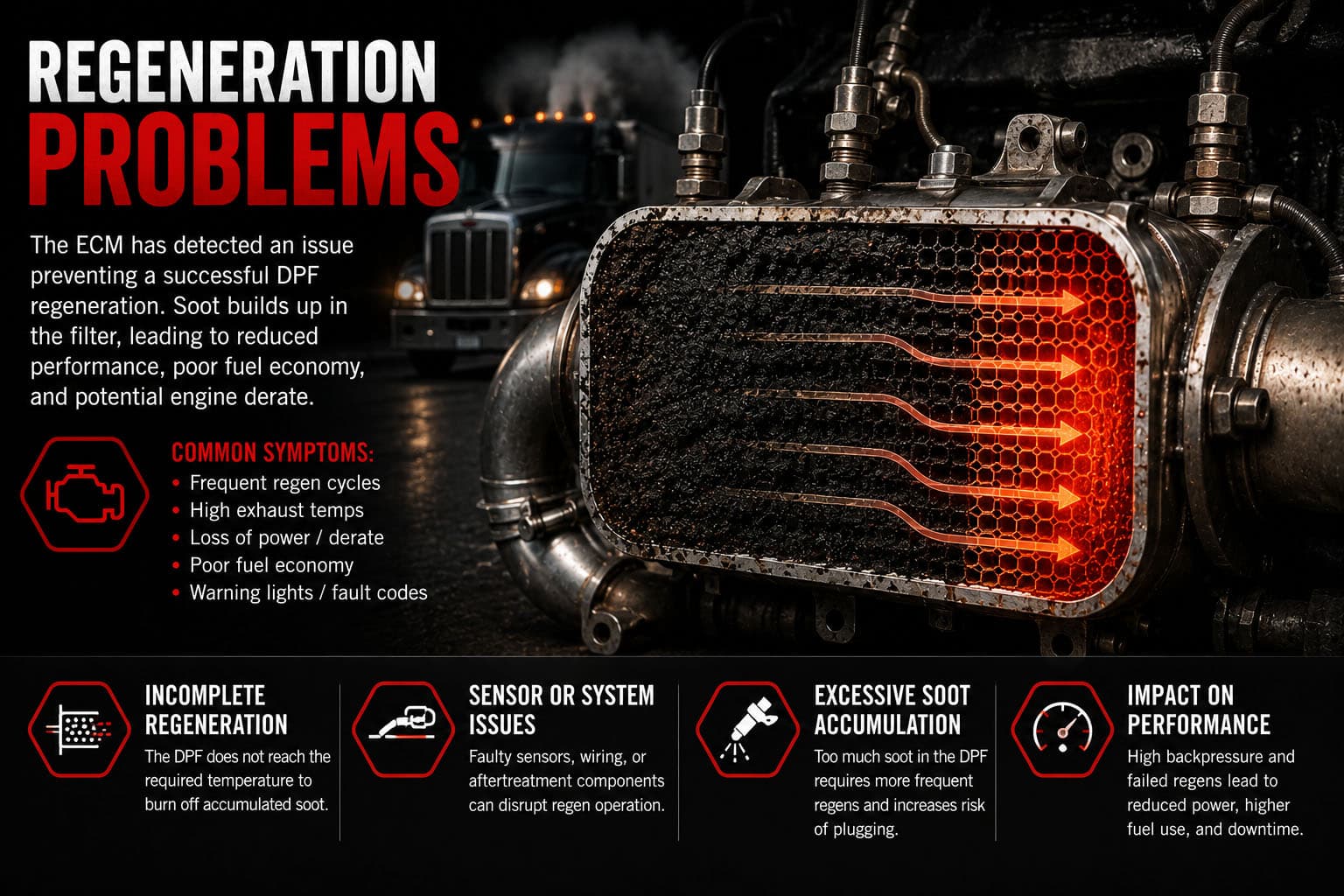
Active regen requires the DPF substrate to reach light-off temperature — the 1100-1200°F range needed to oxidize accumulated soot. In normal conditions, the aftertreatment fuel injector sprays diesel into the exhaust stream, that diesel ignites across the diesel oxidation catalyst (DOC), and DOC light-off raises exhaust temperature into the regen range.
When ambient temperatures drop into sub-zero conditions, every step of this sequence gets harder. The DOC needs higher exhaust input temperature to light off because ambient cooling pulls heat out of the exhaust stream faster. Diesel fuel atomization quality drops at extreme cold. The truck's engine itself produces less exhaust heat at light operational load because more heat goes to cabin and chassis warming instead of exhaust energy.
The result is regen cycles that trigger but never complete, soot accumulating faster than expected, and derate arriving within hours or days of severe weather operation. Operators in northern markets see this pattern annually as the first severe cold of the season arrives.
Operational Profiles Most Affected
Snow plow operations represent the most severe expression of cold-weather regen failure. Plow trucks operate in the coldest available ambient conditions, with brief duty cycles characteristic of weather-event response, frequent stops at intersections and turnarounds, sustained low-speed plowing operation that doesn't produce highway-cycle exhaust temperatures, and the broader operational reality of municipal and state DOT winter service.
Trucks that ran clean through summer and fall start hitting derate within the first major snowstorm of the season. The pattern is predictable enough that fleet operators in northern markets typically plan around it — scheduling pre-winter aftertreatment service, building calibration adjustments into the seasonal maintenance cycle, and accepting some operational disruption as part of winter operational reality.
Beyond snow plow operations, the pattern affects refuse fleets in northern markets, school bus fleets during winter operation, construction operations continuing through winter, fuel and propane delivery in severe-cold regions, and broader vocational fleet operations across the snow belt. Any duty cycle that combines cold ambient with low-RPM short-cycle operation triggers the pattern.
Compounding Factors
Cold-weather diesel fuel itself contributes to the pattern. Diesel ignition delay increases at very low fuel temperatures, producing more soot per combustion cycle. Cold engine oil increases internal friction and changes combustion characteristics. Fuel additives intended to prevent gelling can affect combustion chemistry. The combination produces more soot per operational hour than the calibration's average-case assumptions.
Aftertreatment hardware aging interacts with cold-weather conditions to produce earlier failures than the truck might experience in warmer conditions. A DOC that lights off at 475°F in summer conditions may need 550°F in winter conditions — the difference might be enough to prevent regen completion entirely in severe cold.
The trucks that struggled with regen in summer operations struggle dramatically harder in winter operations. The pattern is the same fundamental issue (DOC light-off insufficient for sustained regen) expressed through more severe operational conditions.
Resolution Approaches
For trucks dedicated to winter vocational service — state DOT snow plows, municipal winter operations, dedicated cold-region fleets — calibration work matched to actual winter operational reality delivers operational improvements. Calibration approaches that account for cold-weather operational patterns rather than the calibration's nominal assumptions can dramatically improve winter operational reliability.
For trucks where the winter operational profile makes recurring aftertreatment service economics unsustainable — particularly snow plow operations where every storm cycle puts trucks in derate — DPF delete with appropriate calibration is a path for off-road operations where regulatory compliance permits. State DOT and municipal operations vary substantially in their aftertreatment compliance requirements, and the path depends on the specific regulatory situation.
For fleet operators in northern markets running mixed inventory across winter-affected platforms, we work through the operational profile, the specific recurring failure patterns, fleet-wide impact analysis, and the appropriate combination of calibration and hardware service that addresses the underlying winter operational reality rather than treating each truck's symptoms individually.
Seasonal Calibration Strategy For Northern Fleets
Fleet operators in northern markets benefit from approaching aftertreatment calibration as a seasonal operational consideration rather than a one-time calibration choice. The calibration that works for the same fleet from May through September often struggles from November through March, and the calibration that works through winter operations may not be optimal during shoulder seasons.
We work with fleet operators in the snow belt — state DOT operations, municipal winter services, northern refuse and school bus fleets, fuel and propane delivery operators in severe-cold regions — on calibration approaches that account for the operational reality across the full annual cycle rather than optimizing only for nominal operating conditions.
For dedicated snow plow operations where the entire operational duty cycle falls within winter conditions, calibration work matched specifically to the winter operational reality typically delivers substantial operational reliability improvements over stock fleet calibration. The trucks operate within a narrower set of conditions than the broader fleet population, which means calibration can be tuned more precisely to those specific conditions.
For mixed-duty fleets that operate across both winter and summer conditions, the conversation gets more complex. Calibration that helps winter operations may not deliver equivalent benefits in summer operations. The right approach depends on the operational mix, the relative criticality of winter versus summer reliability, and the regulatory situation the fleet operates within. For some fleets, seasonal calibration changes make operational sense; for others, a single calibration matched to the more difficult conditions works better operationally.